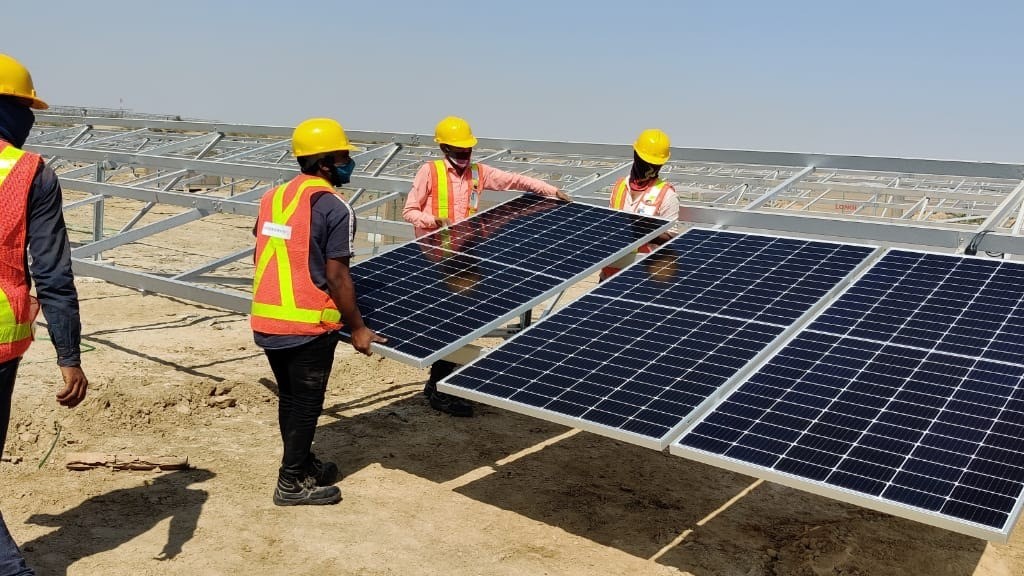
One of the most debated questions in renewable energy valuation is whether investors should require a higher return for projects under construction than for operational assets.
This additional return is commonly referred to as the construction-phase equity premium or construction risk premium. It represents the extra return investors demand to compensate for the risks associated with building an infrastructure asset before it begins generating stable operating cash flows.
While the concept appears intuitive, there is surprisingly little consensus on whether a separate construction risk premium should exist—or how large it should be.
Some investors apply no additional premium, while others increase their required equity return by 100–200 basis points (bps). Understanding which approach is appropriate is important because even small changes in the cost of equity can materially affect project valuations, Levelised Cost of Energy (LCOE) calculations and Power Purchase Agreement (PPA) pricing.
After reviewing both industry evidence and the underlying drivers of construction risk, I believe the case for applying a significant construction premium to renewable energy projects is relatively weak.
Is There an Industry Consensus?
The short answer is no.
Although virtually everyone agrees that projects are riskier during construction than once they are operational, investors and researchers disagree on whether those risks justify a higher required return.
Published estimates generally range from 0% to around 2%.
Two frequently cited references illustrate this divergence:
- EDHEC Survey (2017): Diversified institutional investors reported that, on average, they do not apply an explicit construction risk premium when determining required equity returns.1
- National Renewable Energy Laboratory (NREL): Based on industry interviews, NREL incorporates a 2% construction premium when estimating the cost of equity in its LCOE methodology.2
Among practitioners who do adjust discount rates, the most common range is 100–200 bps.
However, whether such a premium is justified ultimately depends on the underlying sources of construction risk.
1. Macroeconomic Volatility
Construction projects are exposed to changes in inflation, interest rates, foreign exchange movements and input costs.
The longer a project remains under construction, the greater its exposure to these uncertainties and the higher the potential for cost overruns and schedule delays.
This is where renewable energy projects enjoy a significant advantage.
Typical construction periods are remarkably short:
- Utility-scale solar PV: 6–9 months
- Onshore wind: generally around 12–18 months
By comparison, conventional power plants, transport infrastructure and large industrial facilities often require several years to complete.
Because renewable energy projects spend much less time under construction, they are naturally less exposed to adverse macroeconomic developments.
This significantly weakens the case for a large construction risk premium.
2. Construction Complexity
Construction complexity is another major determinant of project risk.
Utility-scale solar and onshore wind projects rely on mature technologies, modular designs and highly standardised construction processes.
These characteristics reduce execution risk by making projects:
- easier to design,
- easier to replicate,
- faster to construct, and
- less vulnerable to unexpected engineering challenges.
Historical evidence supports this view.
Average construction cost overruns are approximately:
- Solar PV: around 1%
- Onshore wind: around 13%
Construction delays are also relatively limited, averaging approximately:
- 1 month for solar
- 2 months for wind
Many projects even achieve commercial operation ahead of schedule.
The contrast with other infrastructure sectors is striking.
Typical average cost overruns are approximately:
- Public transport: 40%
- Oil & gas: 35%
- Ports: 32%
- Mining: 27%
These differences suggest that renewable energy projects—particularly utility-scale solar—carry substantially lower execution risk than most traditional infrastructure assets.
3. Operational Uncertainty
Before a project reaches commercial operation, investors face uncertainty over whether the asset will perform as expected and generate forecast revenues.
This uncertainty comes from two main sources:
Energy production risk
For renewable energy projects, production uncertainty is relatively limited.
For solar PV, the difference between the central production forecast (P50) and the downside case commonly used by lenders (P90) is typically:
- 5–7% for individual projects
- 3–4% for diversified portfolios
Wind projects exhibit slightly greater variability but remain considerably more predictable than many greenfield infrastructure assets.
Electricity price risk
Revenue risk is also reduced because many renewable projects operate under long-term contracted pricing arrangements, including:
- Power Purchase Agreements (PPAs)
- Contracts for Difference (CfDs)
- Other government-backed price support mechanisms
These contracts substantially reduce exposure to volatile merchant electricity prices.
As projects move into operation, uncertainty declines rapidly.
Compared with sectors such as toll roads, airports or first-of-a-kind industrial facilities, renewable energy assets enter operations with relatively limited uncertainty regarding both production and revenues.
Does Renewable Energy Really Need a Construction Risk Premium?
Construction risk undoubtedly exists.
Projects can experience delays, modest cost overruns and commissioning challenges.
However, these risks appear considerably smaller for renewable energy than for most other infrastructure sectors.
The evidence suggests that renewable projects benefit from:
- short construction periods,
- standardised construction techniques,
- relatively low historical cost overruns,
- predictable energy production, and
- stable long-term revenue arrangements.
Taken together, these characteristics materially reduce construction risk.
This helps explain why many diversified infrastructure investors do not apply a separate construction premium at all.
Final Thoughts
The construction-phase equity premium remains one of the least settled assumptions in infrastructure valuation.
While some organisations continue to apply premiums of 100–200 basis points, there is little evidence that renewable energy projects warrant adjustments at the upper end of this range.
Their relatively short construction periods, mature technologies and predictable operating performance mean they are fundamentally less risky than many other infrastructure investments.
For this reason, my view is that any construction risk premium applied to renewable energy projects should be modest—typically no more than 100 basis points—and, for well-diversified investors with robust risk management processes, it may not be necessary at all.
Interested in renewable energy project finance
Explore our free LCOE calculator or download the Solar Project Finance Model.

