
Merchant price risk is one of the most important factors influencing investment decisions in renewable energy.
Unlike projects supported by long-term fixed-price mechanisms, renewable energy assets exposed to the wholesale electricity market face uncertain revenues throughout their operating lives. This additional uncertainty increases the return required by investors and often reduces the amount of debt lenders are willing to provide.
Understanding the size of the merchant risk premium is therefore essential when:
- valuing renewable energy projects;
- negotiating Power Purchase Agreements (PPAs);
- assessing financing structures;
- estimating the appropriate cost of capital.
This article reviews evidence from academic research, investor surveys and current PPA pricing to estimate the additional return investors require for accepting merchant price risk.
Why Merchant Price Risk Matters
Wholesale electricity prices are inherently volatile.
They fluctuate in response to fuel prices, weather conditions, renewable generation, electricity demand, regulatory changes and the overall supply-demand balance within the power market. This volatility exists both within a single day and across multiple years.
Revenue uncertainty translates directly into investment risk.
As uncertainty increases, investors require higher expected returns before committing capital. Likewise, lenders become more conservative because unpredictable revenues compromise projects’ ability to serve debt affecting their risk profile.
Long-term Power Purchase Agreements (PPAs) help mitigate this uncertainty by fixing part or all of the electricity price over a defined period.
However, this certainty comes at a cost.
Across Europe, PPA prices typically include a discount relative to expected merchant electricity prices. Depending on market conditions, technology and contract structure, this discount generally ranges between 10% and 30%.
In effect, renewable energy investors exchange higher expected returns for greater revenue certainty.
Although, the lower revenue cash flows are offset by the reduction in the funding costs obtained from incorporating debt sources into the capital structure as the cost of equity funds generally exceeds debt ones.
Estimating the Merchant Risk Premium
Although merchant price risk cannot be observed directly, it can be estimated using several independent approaches.
This article reviews evidence from three complementary sources:
- Academic research
- Investor surveys
- The implicit pricing embedded in Power Purchase Agreements (PPAs)
The remarkable consistency between these approaches provides confidence that the merchant risk premium can be estimated with reasonable accuracy.
Academic Research
A 2020 study by researchers at Imperial College London estimated that exposing UK renewable energy projects to merchant electricity prices increases the required cost of capital by approximately 200 to 300 basis points, depending on technology and investment horizon.
The researchers compared projects operating entirely under merchant prices with equivalent projects benefiting from fixed-price mechanisms such as:
- Power Purchase Agreements (PPAs)
- Contracts for Difference (CfDs)
- Feed-in Tariffs (FiTs)
The analysis was based on 10,000 simulations of future electricity prices.
The merchant risk premium was calculated as the additional return required to compensate investors for accepting uncertain future revenues instead of relatively predictable cash flows under fixed-price arrangements.
The study reached two important conclusions:
- the merchant premium increases as the investment horizon becomes longer;
- wind projects generally require a higher premium than solar projects because of their greater exposure to electricity price uncertainty.

Evidence from Renewable Energy Investors
Academic research is supported by investor surveys.
Grant Thornton’s survey of renewable energy investors assessed the willingness of investors to finance subsidy-free renewable energy projects across several countries.
For investors prepared to accept merchant exposure, the survey also quantified the additional return they would require.
The results show that:
- investors in Australia and France generally require an additional 200 basis points;
- investors in Germany and the Nordic countries require a lower premium of approximately 50 to 100 basis points

The survey also highlights a broader market reality.
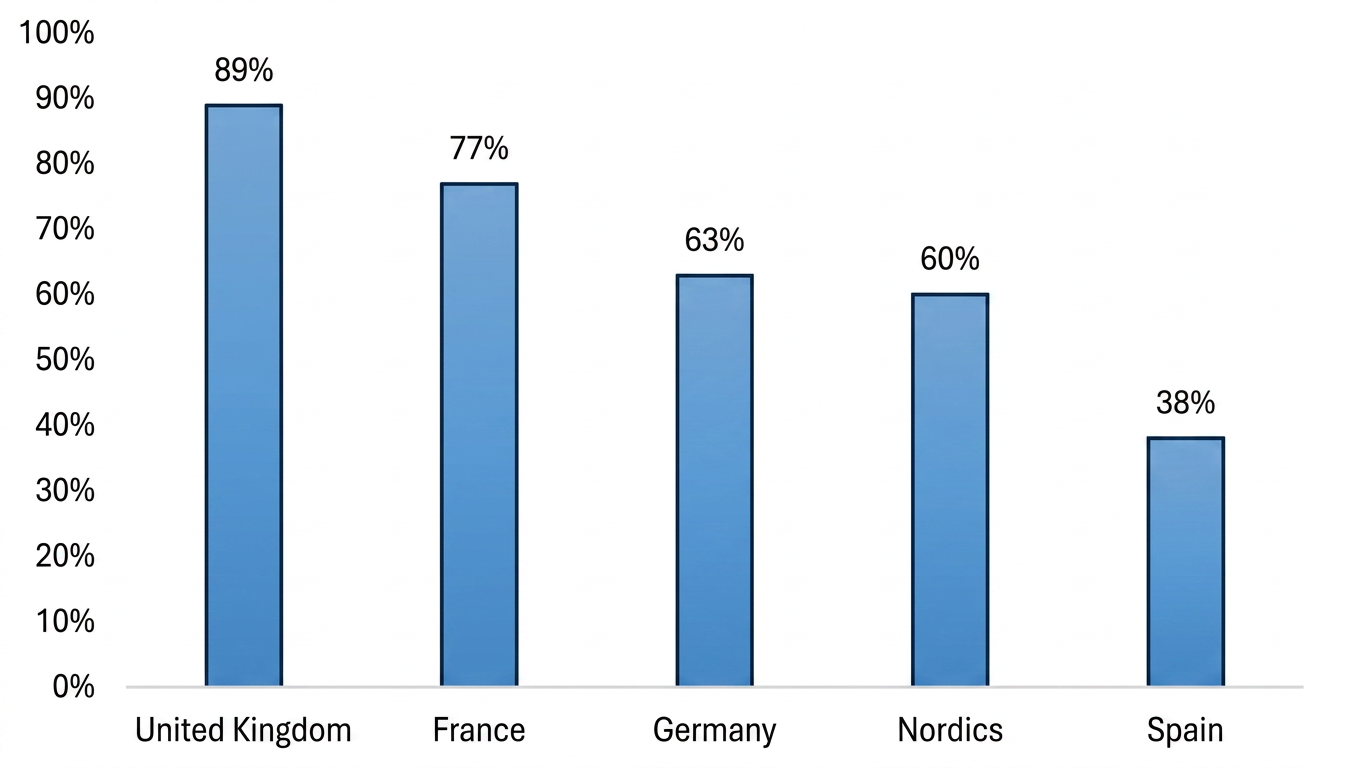
Most renewable energy investors remain reluctant to invest without some form of revenue stabilisation mechanism.
This preference is particularly strong in the United Kingdom, whereas investors in Spain demonstrate a greater willingness to accept merchant price exposure
The Merchant Premium Embedded in Power Purchase Agreements
The third source of evidence comes directly from market pricing.
Across Europe, long-term PPAs are commonly priced at a discount of approximately 10% to 30% relative to expected merchant electricity prices.
Although pricing varies by country, technology and contract duration, these discounts represent the value investors are willing to sacrifice in exchange for eliminating merchant price risk.
To quantify the implied merchant premium, I modelled a representative utility-scale solar project using the assumptions below.

The project generates a 10% pre-tax unlevered internal rate of return (IRR) under a full merchant price scenario.
I then evaluated the impact of progressively lower PPA prices, applying discounts from 10% to 30% over a 15-year contract while assuming merchant revenues thereafter.

The implied merchant premium ranges between 106 and 309 basis points.
Since PPA discounts between 10% and 20% are considerably more common in today’s European market, the corresponding merchant premium of approximately 100 to 220 basis points appears the most representative.
Importantly, this range closely aligns with both academic research and investor surveys.
Key Takeaways
Three independent sources point towards remarkably similar conclusions.
Academic research, investor surveys and observed PPA pricing all indicate that renewable energy investors require approximately 100 to 200 basis points of additional return when accepting merchant price risk.
The evidence also suggests that:
- merchant price risk increases the required cost of capital;
- longer merchant exposure results in higher required returns;
- wind projects generally command a larger premium than solar projects;
- fixed-price mechanisms such as PPAs, CfDs and FiTs significantly reduce financing risk and improve investment certainty.
For developers, investors and lenders, understanding the merchant risk premium is fundamental when valuing renewable energy projects, negotiating PPAs and selecting appropriate discount rate

